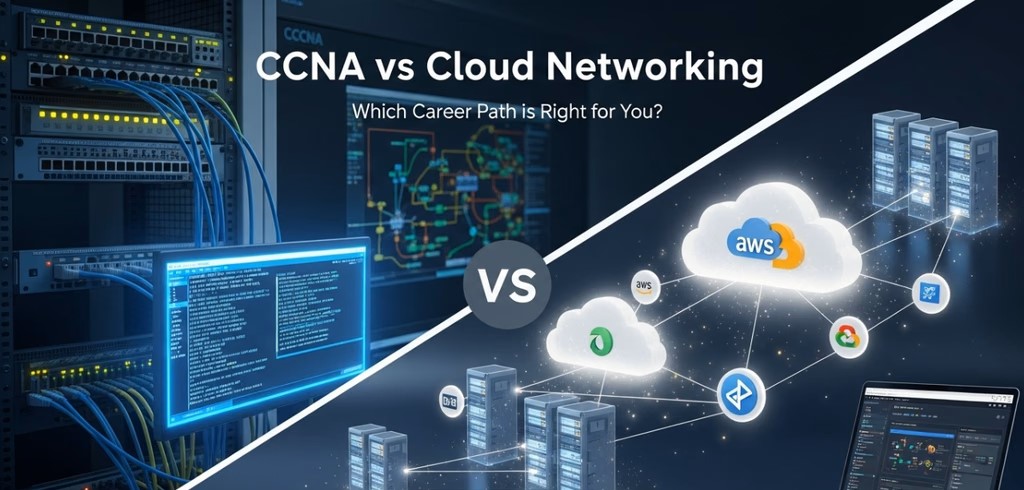
If you are a beginner planning to build a career in networking or cloud computing, you may be wondering: Should I learn CCNA first or Cloud Computing?
Both areas are important in modern IT infrastructure. Networking provides the foundation for understanding how devices and systems communicate, while cloud computing builds on these concepts to deliver computing resources over the internet.
For many beginners, learning basic networking concepts before moving deeper into cloud computing can make the cloud easier to understand.
What Is CCNA?
CCNA stands for Cisco Certified Network Associate. It is associated with foundational networking knowledge and covers important concepts used in modern computer networks.
A beginner studying CCNA-related topics can learn about:
-
IP addressing
-
IPv4 and IPv6
-
Subnetting
-
Ethernet
-
VLANs
-
Routing
-
Switching
-
TCP/IP
-
Network security fundamentals
-
Wireless networking
-
Network troubleshooting
These concepts help you understand how computers, servers, switches, routers, and other devices communicate.
What Is Cloud Computing?
Cloud computing refers to delivering computing resources and services over a network, usually the internet.
Cloud environments can provide services such as:
-
Virtual machines
-
Storage
-
Databases
-
Networking
-
Security services
-
Applications
-
Monitoring and management tools
Major cloud platforms include AWS, Microsoft Azure, and Google Cloud.
Should a Beginner Learn CCNA or Cloud Computing First?
There is no single path that works for everyone.
However, if you have little or no IT background, learning basic networking first can be helpful.
Why?
Because cloud environments still rely heavily on networking concepts. When you understand IP addresses, DNS, routing, subnets, ports, firewalls, and network security, many cloud networking concepts become easier to understand.
A practical learning sequence can be:
Computer Fundamentals → Networking Basics → CCNA-Level Networking → Linux → Cloud Fundamentals → Cloud Networking → Cloud Security
You do not necessarily need to complete the entire CCNA certification before touching cloud computing. You can start learning cloud fundamentals once you have a comfortable understanding of basic networking.
Step 1: Learn Computer Fundamentals
Start with the basics.
Understand:
-
Hardware and software
-
Operating systems
-
Servers and clients
-
Files and folders
-
Users and permissions
-
Basic troubleshooting
-
Virtualization fundamentals
This foundation will help you understand networking and cloud concepts more easily.
Step 2: Learn Networking Basics
Before moving into advanced cloud topics, learn the fundamentals of networking.
Focus on:
-
IP addresses
-
MAC addresses
-
DNS
-
DHCP
-
TCP/IP
-
Ports
-
Protocols
-
Routers
-
Switches
-
Firewalls
-
LAN and WAN
These are essential concepts for both networking and cloud computing.
Step 3: Learn CCNA-Level Networking
Once you understand basic networking, you can move toward CCNA-level concepts.
Important areas include:
IP Addressing
Learn how IPv4 and IPv6 addresses work and how devices are identified on a network.
Subnetting
Subnetting is an important networking skill. Practice calculating network addresses, host ranges, and subnet sizes.
Switching
Learn concepts such as:
-
VLANs
-
Trunking
-
MAC addresses
-
Ethernet
-
Switching fundamentals
Routing
Understand how routers forward traffic between different networks.
Learn basic concepts related to:
-
Static routing
-
Dynamic routing
-
Routing tables
-
Default routes
Network Security
Learn the fundamentals of:
-
Firewalls
-
Access control
-
Secure protocols
-
Network segmentation
-
Basic security practices
Step 4: Learn Linux Basics
Linux is useful in both networking and cloud environments.
Beginners should learn:
-
Linux commands
-
Files and directories
-
Users and groups
-
Permissions
-
Processes
-
Networking commands
-
Package management
-
Basic shell scripting
You do not need to become a Linux expert immediately. Start with the basics and practice regularly.
Step 5: Start Cloud Computing
After developing a networking foundation, start learning cloud computing.
Begin with the basic cloud concepts:
-
What is cloud computing?
-
Public cloud
-
Private cloud
-
Hybrid cloud
-
Virtual machines
-
Cloud storage
-
Cloud networking
-
Scalability
-
Availability
-
Backup and disaster recovery
Then explore one major cloud platform rather than trying to learn all platforms simultaneously.
Step 6: Learn Cloud Networking
This is where your networking knowledge becomes particularly useful.
Learn concepts such as:
-
Virtual networks
-
Subnets
-
Routing
-
Security groups
-
Network access controls
-
Load balancing
-
VPN
-
DNS
-
Private and public IP addresses
Understanding these concepts can help you connect your CCNA knowledge with cloud infrastructure.
Step 7: Practice With Projects
Theory alone is not enough.
Create practical projects such as:
Project 1: Design a small office network.
Project 2: Configure VLANs in a networking lab.
Project 3: Create a virtual network in a cloud platform.
Project 4: Deploy a virtual machine.
Project 5: Configure basic cloud security rules.
Project 6: Connect different network segments and document the configuration.
Projects can help you demonstrate your skills when preparing for internships and entry-level IT roles.
CCNA vs Cloud Computing: What Should You Focus On?
| Area | CCNA / Networking | Cloud Computing |
|---|---|---|
| Main focus | Computer networks | Cloud infrastructure and services |
| Important skills | Routing, switching, IP addressing | Compute, storage, networking |
| Useful for | Network-related roles | Cloud and infrastructure roles |
| Linux knowledge | Helpful | Very useful |
| Security knowledge | Important | Important |
| Networking knowledge | Core | Essential |
| Practical labs | Very useful | Very useful |
These are not necessarily competing career paths. Networking and cloud computing often complement each other.
Possible Career Paths
After developing the right skills and gaining practical experience, beginners can explore roles such as:
-
Network Support Engineer
-
Network Administrator
-
IT Support Engineer
-
NOC Engineer
-
Cloud Support Associate
-
Cloud Administrator
-
Junior Cloud Engineer
-
Infrastructure Support Engineer
The exact requirements vary by employer and role.
A Beginner-Friendly Learning Roadmap
If you are starting from zero, consider this sequence:
1. Computer Fundamentals
↓
2. Networking Basics
↓
3. CCNA-Level Networking
↓
4. Linux Fundamentals
↓
5. Cloud Computing Fundamentals
↓
6. Cloud Networking
↓
7. Cloud Security
↓
8. Hands-on Projects
↓
9. Certification & Job Preparation
Final Thoughts
If you are completely new to IT, start with computer and networking fundamentals before going deep into cloud computing.
Learning CCNA-level networking can give you a strong understanding of IP addressing, routing, switching, network security, and troubleshooting. You can then apply those concepts to cloud environments.
The goal should not be to learn everything at once. Build your foundation step by step, practice through labs, complete projects, and gradually move toward advanced networking and cloud technologies.
If you want to develop practical skills in CCNA Networking, Cloud Computing, Cyber Security, Linux, and other IT technologies, explore the learning programs available at Global SkillTech.
Learn practical IT skills and take the next step toward your technology career.
Visit: https://globalskilltech.in/