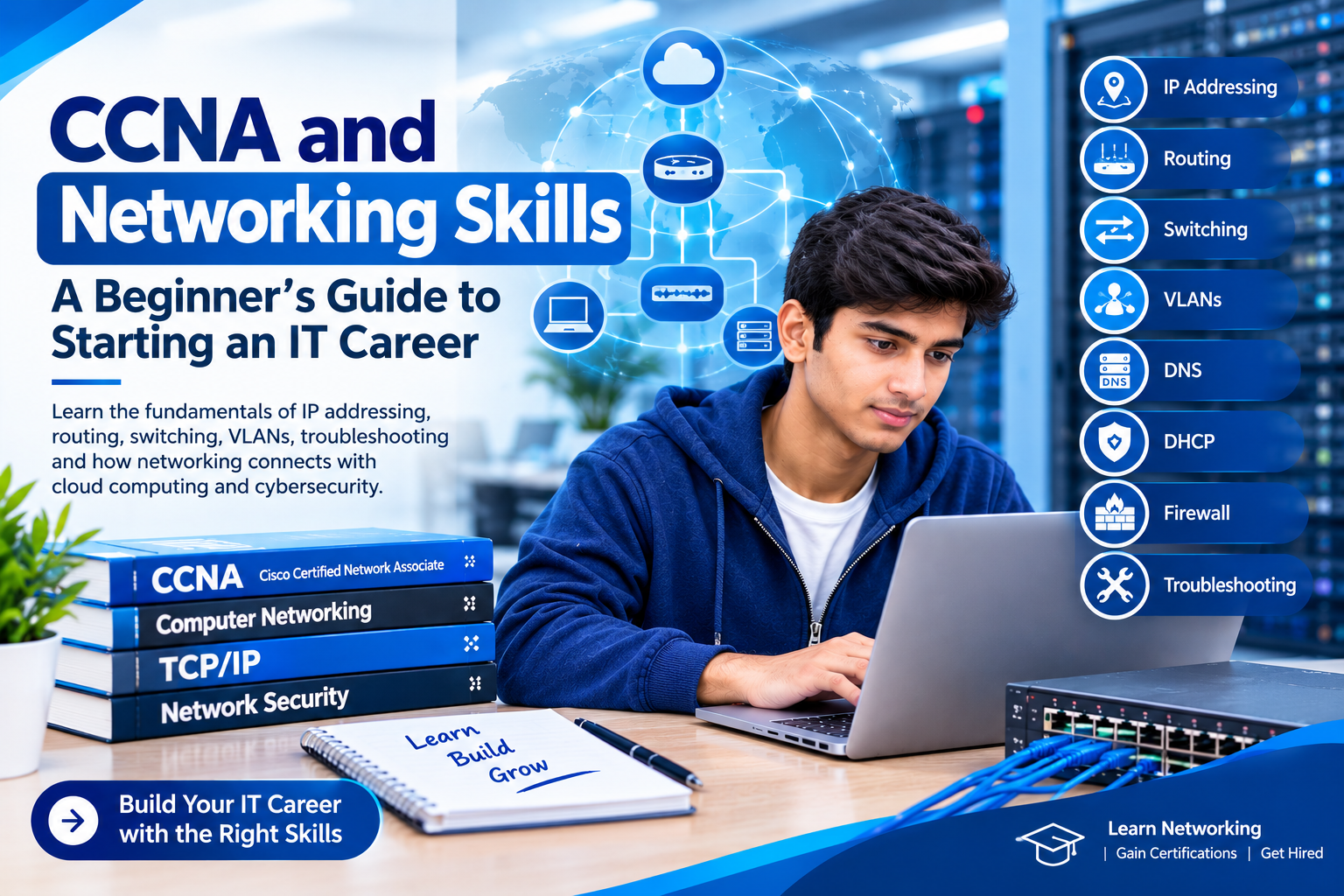
CCNA and networking skills are important foundations for students who want to build a career in IT infrastructure, network administration, cloud computing or cybersecurity.
Every organisation depends on networks to connect computers, servers, applications and users. Because of this, understanding how networks work can help beginners build a strong technical foundation.
What Is Computer Networking?
Computer networking is the process of connecting computers and other devices so they can communicate and exchange data.
A beginner learning networking usually starts with concepts such as:
-
IP Addressing
-
TCP/IP
-
OSI Model
-
Subnetting
-
Routers
-
Switches
-
VLANs
-
DNS
-
DHCP
-
Routing
-
Network Troubleshooting
-
Firewalls
Understanding these concepts makes it easier to troubleshoot network problems and work with IT infrastructure.
What Is CCNA?
CCNA, or Cisco Certified Network Associate, is associated with foundational networking knowledge and Cisco networking technologies.
CCNA-level learning can introduce students to networking concepts such as IP addressing, routing, switching, VLANs and network troubleshooting.
For beginners, the goal should not be only to prepare for an examination. It is also important to understand how networks actually work.
Why Learn Networking?
Networking is connected with many areas of IT.
A student who starts with networking can later explore:
-
Network Administration
-
Network Engineering
-
IT Support
-
Cloud Computing
-
Network Security
-
Cybersecurity
-
IT Infrastructure
Networking knowledge is particularly useful when moving towards cloud computing and cybersecurity, because both areas depend on understanding how systems communicate.
Important Networking Skills for Beginners
1. IP Addressing
IP addresses allow devices to communicate over a network.
Students should understand IPv4, IPv6, private and public IP addresses, subnet masks and basic subnetting.
2. Routing and Switching
Routers connect different networks, while switches connect devices within a network.
Understanding routing and switching is an important part of networking fundamentals.
3. VLANs
VLANs allow a physical network to be logically divided into different network segments.
Learning VLAN concepts helps students understand how organisations can separate users and network resources.
4. DNS and DHCP
DNS helps translate domain names into IP addresses, while DHCP can automatically provide network configuration to devices.
Both are commonly encountered in IT environments.
5. Network Troubleshooting
Networking professionals need to identify and resolve connectivity problems.
Students should practise checking IP configuration, connectivity, DNS resolution, routing and other common network issues.
Practical Networking Learning
Networking becomes easier to understand when students practise with labs.
For example, a beginner can create a small office network using Cisco Packet Tracer and practise:
-
Connecting computers
-
Configuring switches
-
Assigning IP addresses
-
Creating VLANs
-
Configuring routing
-
Testing connectivity
-
Troubleshooting network problems
Practical projects can help students understand the difference between simply knowing networking terms and actually applying them.
Networking and Cybersecurity
Networking is also closely connected with cybersecurity.
Security professionals need to understand network traffic, ports, protocols, firewalls, routing and communication between systems.
Students interested in cybersecurity can therefore benefit from building networking fundamentals before moving into more advanced security topics.
Networking and Cloud Computing
Cloud environments also depend on networking.
When learning cloud computing, students may encounter concepts such as virtual networks, subnets, routing, security groups, DNS and load balancing.
This is why networking can provide a useful foundation for students who later want to move into Cloud Computing, AWS, Azure or Cloud Security.
Who Should Learn CCNA and Networking?
Networking can be suitable for:
-
12th-pass students interested in IT
-
Diploma students
-
BCA and BSc students
-
BTech students
-
IT support beginners
-
Students interested in cybersecurity
-
Students interested in cloud computing
-
Anyone interested in IT infrastructure
You do not need to learn every networking technology at once. Start with the fundamentals and gradually increase the difficulty.
How to Start Learning Networking
A simple learning path can be:
Step 1: Learn computer fundamentals
Step 2: Understand the OSI and TCP/IP models
Step 3: Learn IPv4 and subnetting
Step 4: Study switches and routers
Step 5: Learn VLANs and routing
Step 6: Understand DNS and DHCP
Step 7: Practise using Cisco Packet Tracer
Step 8: Build small networking projects
Step 9: Learn basic network security
Step 10: Prepare for entry-level networking roles
The uploaded Global SkillTech career guide also identifies networking as a beginner-accessible IT skill and highlights IP addressing, subnetting, VLANs, routing, switching, DNS, DHCP, firewalls and troubleshooting as important areas to learn.
Career Opportunities After Learning Networking
After developing networking knowledge and practical skills, learners can explore entry-level roles such as:
-
Network Support Engineer
-
Network Technician
-
IT Support Engineer
-
NOC Technician
-
Junior Network Administrator
With additional experience and specialisation, learners can move towards areas such as network security, cloud networking and infrastructure.
Learn Networking With Practical Skills
At Global SkillTech, students can explore networking and IT infrastructure programs covering networking fundamentals, practical labs and related technologies such as cloud computing and cybersecurity.
The focus should be on understanding concepts, practising through labs and developing skills that can be demonstrated in real-world scenarios.
Final Thoughts
CCNA and networking skills can provide a strong foundation for an IT career.
Instead of trying to learn everything at once, start with computer fundamentals, networking concepts, IP addressing, routing, switching and troubleshooting. Then gradually explore cloud computing, cybersecurity or other specialised IT areas.
Consistent practice and practical projects can make your learning journey more useful and career-focused.
Ready to Start Your Networking Journey?
Explore networking and IT career programs at Global SkillTech and start building practical technology skills.
👉 Visit: https://globalskilltech.in/