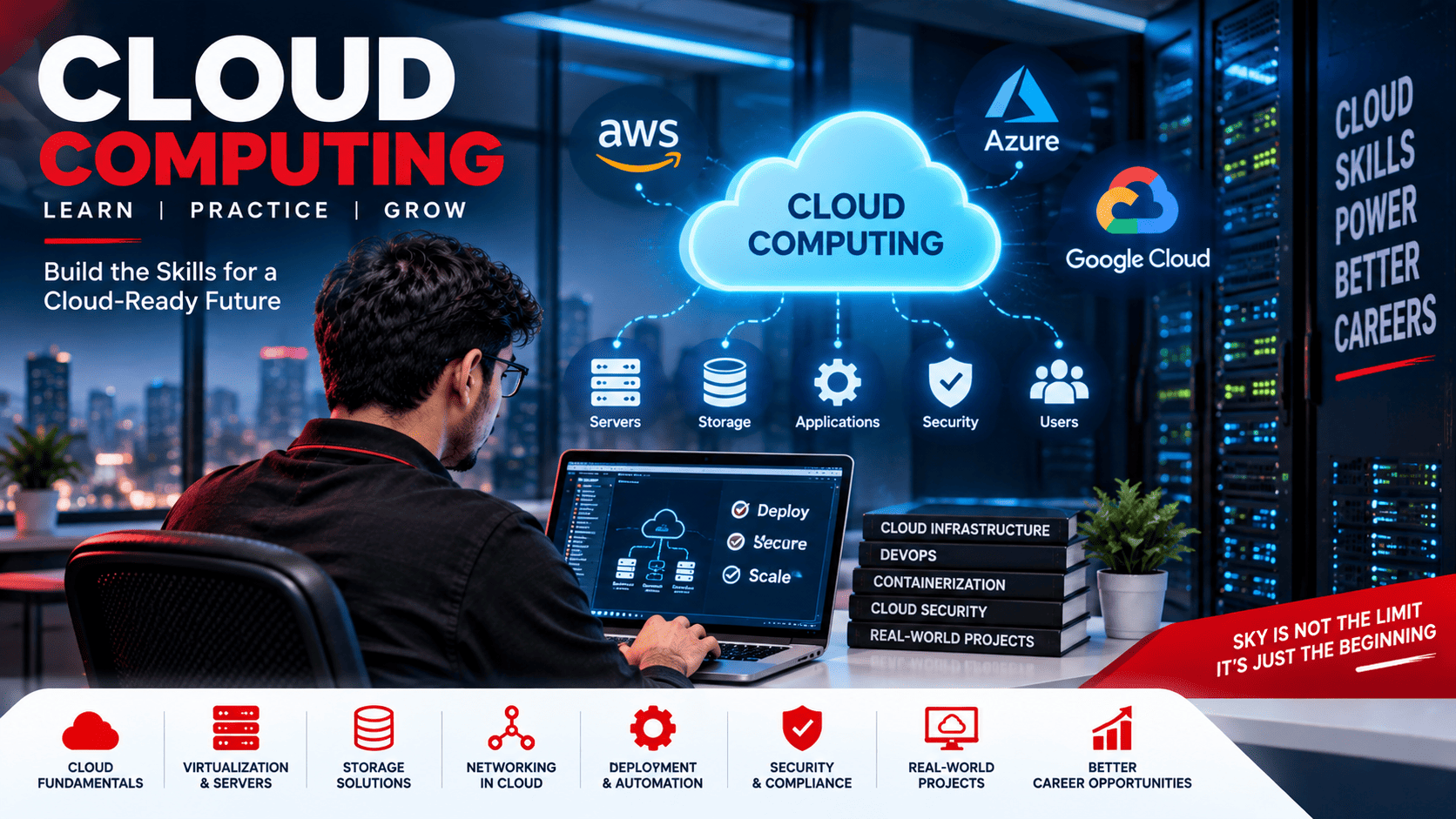
Cloud computing has become an important part of modern IT infrastructure. Businesses use cloud platforms for applications, storage, databases, networking and many other technology services.
For students interested in IT infrastructure, networking and system administration, cloud computing can be an area worth exploring.
What Is Cloud Computing?
Cloud computing means using computing resources such as servers, storage, databases and applications through the internet instead of managing all physical infrastructure locally.
Major cloud platforms include AWS, Microsoft Azure and Google Cloud.
A beginner does not need to learn everything at once. A better approach is to understand the fundamentals first.
What Should You Learn for a Cloud Computing Career?
A strong beginner roadmap can include:
-
Computer fundamentals
-
Networking basics
-
Linux fundamentals
-
Cloud computing concepts
-
Virtualization
-
Cloud security basics
-
Identity and Access Management
-
AWS or Azure fundamentals
-
Basic scripting
-
Practical cloud projects
Networking and Linux are particularly useful because cloud environments depend heavily on infrastructure and operating-system concepts.
Practical Cloud Projects
Instead of only watching tutorials, beginners can practise with small projects.
For example, you can:
-
Host a simple website using cloud storage.
-
Create a virtual machine.
-
Configure basic networking.
-
Set up a database.
-
Practise backup and monitoring.
-
Learn basic cloud security settings.
These projects can help you understand how cloud services work in real environments.
Cloud Computing and Cybersecurity
Cloud and cybersecurity are closely connected. As organisations move applications and data to cloud platforms, understanding identity management, access control, network security and data protection becomes increasingly important.
This is why some IT learning paths combine Networking + Linux + Cloud Computing + Cybersecurity.
Global SkillTech's programs include cloud computing, AWS/Azure concepts, Linux, virtualization, networking and cybersecurity modules.
Start Building Your Cloud Career
If you are a beginner, do not try to learn AWS, Azure, Linux, networking and DevOps simultaneously.
Start with the fundamentals, select one cloud platform, practise regularly and build projects.
A structured cloud computing course can provide a learning path covering fundamentals, practical labs and career preparation.
Explore Cloud Computing and other IT programs at: