Getting your first IT job can feel difficult.
You have completed your graduation. You may have completed a few courses and collected some certificates. But when you start searching for jobs, many descriptions ask for experience.
Then you start wondering:
“How can I get experience when nobody gives me my first job?”
The answer is simple: you don't need to know everything before applying for your first IT job. You need to become job-ready for a specific role.
That means learning the right skills, getting practical experience, building projects, preparing your resume and learning how to present yourself in an interview.
Here is a practical roadmap for getting your first IT job as a fresher.
1. Choose Your IT Career Path
The first step is to decide what type of IT job you want.
Many freshers make the mistake of applying for every technology job they find. One day they prepare for networking, the next day cybersecurity, and then software development.
Instead, choose one primary career direction.
If you enjoy computers and troubleshooting, consider IT Support.
If you enjoy networking, consider Networking or CCNA.
If you are interested in security, consider Cybersecurity.
If you enjoy programming, consider Software Development.
If you like numbers and business, consider Data Analytics.
If you are interested in infrastructure, consider Cloud Computing.
Your first goal is not to become an expert.
Your first goal is to become job-ready for one role.
2. Learn the Fundamentals
Once you choose your career path, build a strong foundation.
For networking, learn IP addressing, subnetting, TCP/IP, routing, switching, VLANs, DHCP and DNS.
For cybersecurity, learn networking, Linux, Windows, security fundamentals, vulnerabilities, authentication, firewalls and security monitoring.
For data analytics, learn Excel, SQL, Power BI, data cleaning and basic statistics.
For software development, learn programming fundamentals, databases, APIs, version control and web technologies.
Don't rush into advanced topics before understanding the basics.
Strong fundamentals make advanced learning much easier.
3. Get Hands-On Experience
Completing a course is only the beginning.
Employers may ask:
“What have you actually worked on?”
You need to have an answer.
Create a lab.
Build a project.
Solve a technical problem.
For networking, create a network using Cisco Packet Tracer.
For cybersecurity, build a controlled security lab and practise log analysis or network monitoring.
For cloud computing, deploy and configure a virtual machine and explore cloud services.
For data analytics, create a Power BI dashboard.
For software development, build an actual application.
You don't need expensive equipment.
You need consistent practice.
4. Build 2–4 Strong Projects
You don't need dozens of projects on your resume.
A few relevant projects can be much more useful.
For example, a cybersecurity fresher could build:
• Security Monitoring Lab
• Vulnerability Assessment Lab
• Network Traffic Analysis Project
A networking fresher could build:
• Small Business Network
• VLAN and Routing Lab
• Network Troubleshooting Project
A data analytics fresher could build:
• Sales Dashboard
• Customer Analysis Dashboard
• Business Performance Dashboard
During an interview, you should be able to explain what you built, why you built it, which technologies you used and what problems you solved.
5. Create a Professional Fresher Resume
Your resume should be simple, focused and relevant.
Include:
• Career Objective
• Technical Skills
• Certifications
• Projects
• Internship or Training
• Education
• Achievements
Don't fill your resume with technologies you have only heard about.
If you mention a technology, be prepared to answer questions about it.
A focused and honest resume is better than a long list of skills you cannot demonstrate.
6. Build Your LinkedIn Profile
Your resume isn't the only thing recruiters may see.
Create a professional LinkedIn profile with:
• Professional photograph
• Clear headline
• About section
• Technical skills
• Certifications
• Projects
• Education
• Internship or training experience
Instead of simply writing “Looking for a job,” explain what you are learning and what type of role you want.
For example:
“Aspiring Cybersecurity Professional | Networking & Linux | Security Labs | SOC Fundamentals”
This immediately communicates your career direction.
7. Prepare for Technical Interviews
Getting an interview is only the beginning.
Prepare questions related to the role you are applying for.
For IT Support, prepare Windows, hardware, networking, troubleshooting and basic security.
For networking, prepare OSI Model, TCP/IP, subnetting, VLANs, routing, switching, DNS and DHCP.
For cybersecurity, prepare CIA Triad, threats, vulnerabilities, authentication, firewalls, IDS/IPS, SIEM and incident response.
For data analytics, prepare Excel, SQL, Power BI, data cleaning and basic statistics.
For software development, prepare programming fundamentals, databases, APIs, OOP and Git.
Don't simply memorize answers.
Understand the concepts.
8. Prepare Your Self-Introduction
One of the first questions in an interview is often:
“Tell me about yourself.”
Keep your answer short and relevant.
Talk about your education, technical interests, skills, projects and the type of role you are targeting.
For example:
“I recently completed my graduation and developed an interest in cybersecurity. I have built my foundation in networking, Linux and security fundamentals. I have also worked on practical security labs involving network monitoring and log analysis. I am now looking for an entry-level opportunity where I can apply these skills and continue learning.”
Keep it professional and confident.
9. Don't Wait Until You Feel 100% Ready
Many freshers spend months learning one more course, one more certification and one more technology.
Then they still don't apply.
You don't need to know everything before starting your job search.
Once you have:
Skills + Practical Experience + Projects + Resume
start applying.
At the same time, continue learning.
Your first job is the beginning of your professional learning journey.
10. Apply for Relevant Entry-Level Roles
Target jobs that match your preparation.
Networking skills can lead to opportunities such as:
• NOC Executive
• Network Support
• IT Support
Cybersecurity skills can lead to opportunities such as:
• SOC Trainee
• Entry-Level SOC Analyst
• Security Support
Data skills can lead to:
• Junior Data Analyst
• MIS Executive
• Reporting Analyst
Development skills can lead to:
• Junior Developer
• Software Trainee
• Web Developer
Cloud skills can lead to:
• Cloud Support
• Technical Support
• Junior Cloud Administrator
Always read the job description carefully before applying.
11. Consider Internships and Practical Training
Your first professional opportunity doesn't always have to be a permanent job.
Internships, apprenticeships and practical training can help you understand how professional IT environments work.
They can also give you something valuable:
Real experience.
If you are still studying, don't wait until graduation to start building your portfolio.
Start early.
12. Use AI as a Learning Assistant
AI tools can also help freshers prepare for their careers.
You can use AI to:
• Practise interview questions
• Review your resume
• Understand difficult technical concepts
• Create study plans
• Practise communication
• Generate mock interview scenarios
• Review project documentation
But don't depend on AI to do everything for you.
Use AI to improve your learning, not replace it.
You should understand every technology and project mentioned on your resume.
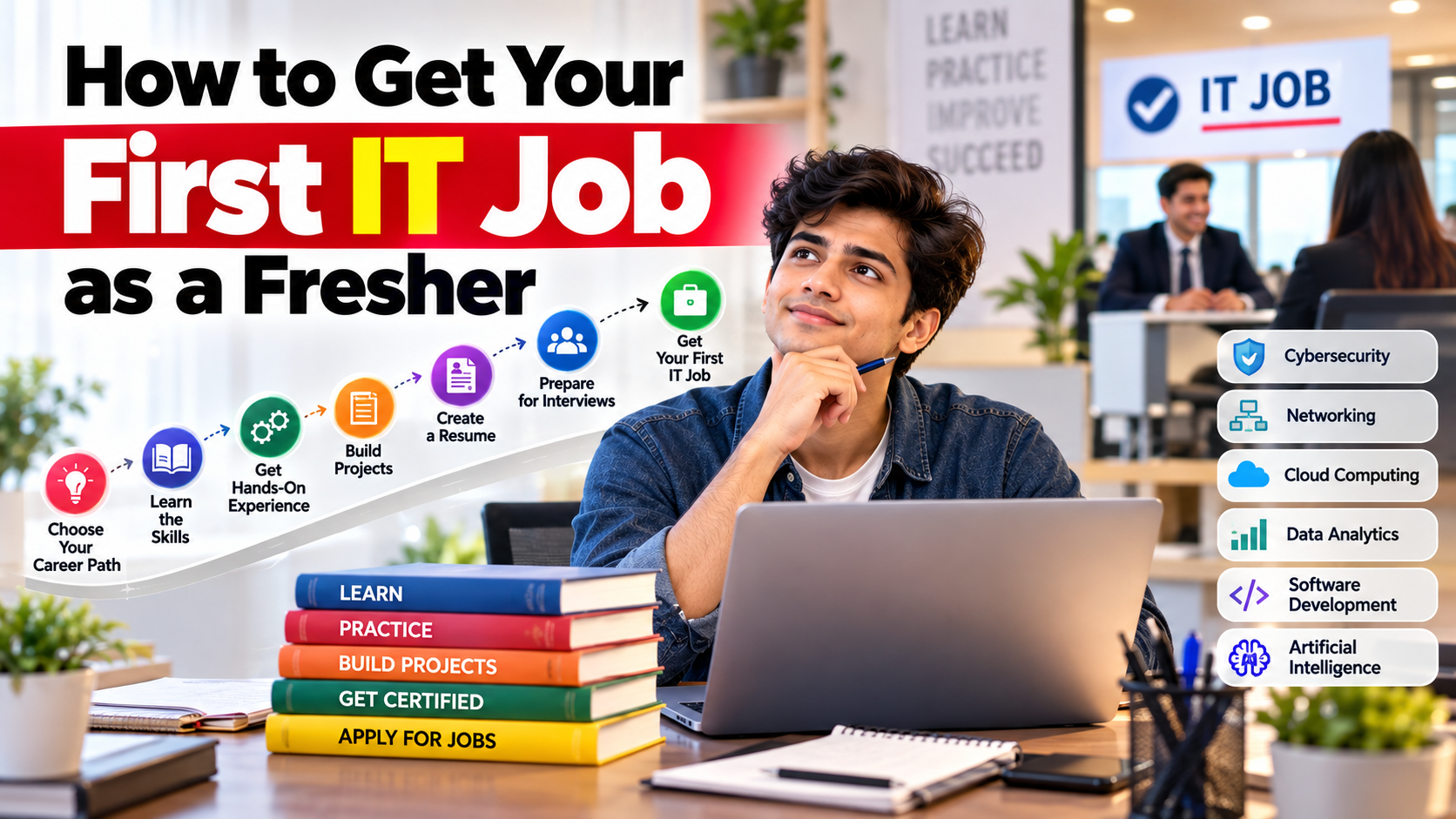
The Fresher IT Career FormulaChoose → Learn → Practise → Build → Prepare → Apply → Improve
Choose one career path.
Learn the fundamentals.
Practise through hands-on labs.
Build practical projects.
Prepare your resume and interviews.
Apply for relevant opportunities.
Learn from every interview and keep improving.
What If You Don't Have Any Experience?Remember:
You may not have professional experience, but you can have practical experience.
Your projects.
Your labs.
Your internship.
Your training.
Your certifications.
Your portfolio.
All of these can demonstrate your preparation.
Your goal is to show an employer:
“I may be a fresher, but I have already started doing the work.”
Final ThoughtsGetting your first IT job isn't about knowing every technology.
It is about becoming useful in one specific area.
Choose your career path.
Learn the fundamentals.
Practise through hands-on labs.
Build real projects.
Create a focused resume.
Prepare for interviews.
Apply consistently.
And keep improving.
Your first IT job may not be your dream job.
But it can be the first step toward your long-term technology career.
Don't wait until you know everything.
Start learning.
Start building.
Start applying.
Your IT career can begin with one skill, one project and one opportunity.
Start Your IT Career with Global SkillTech
Global SkillTech provides career-focused training in Cybersecurity, Networking, Cloud Computing, IT Infrastructure, AI and Data Analytics with a focus on practical, hands-on learning.