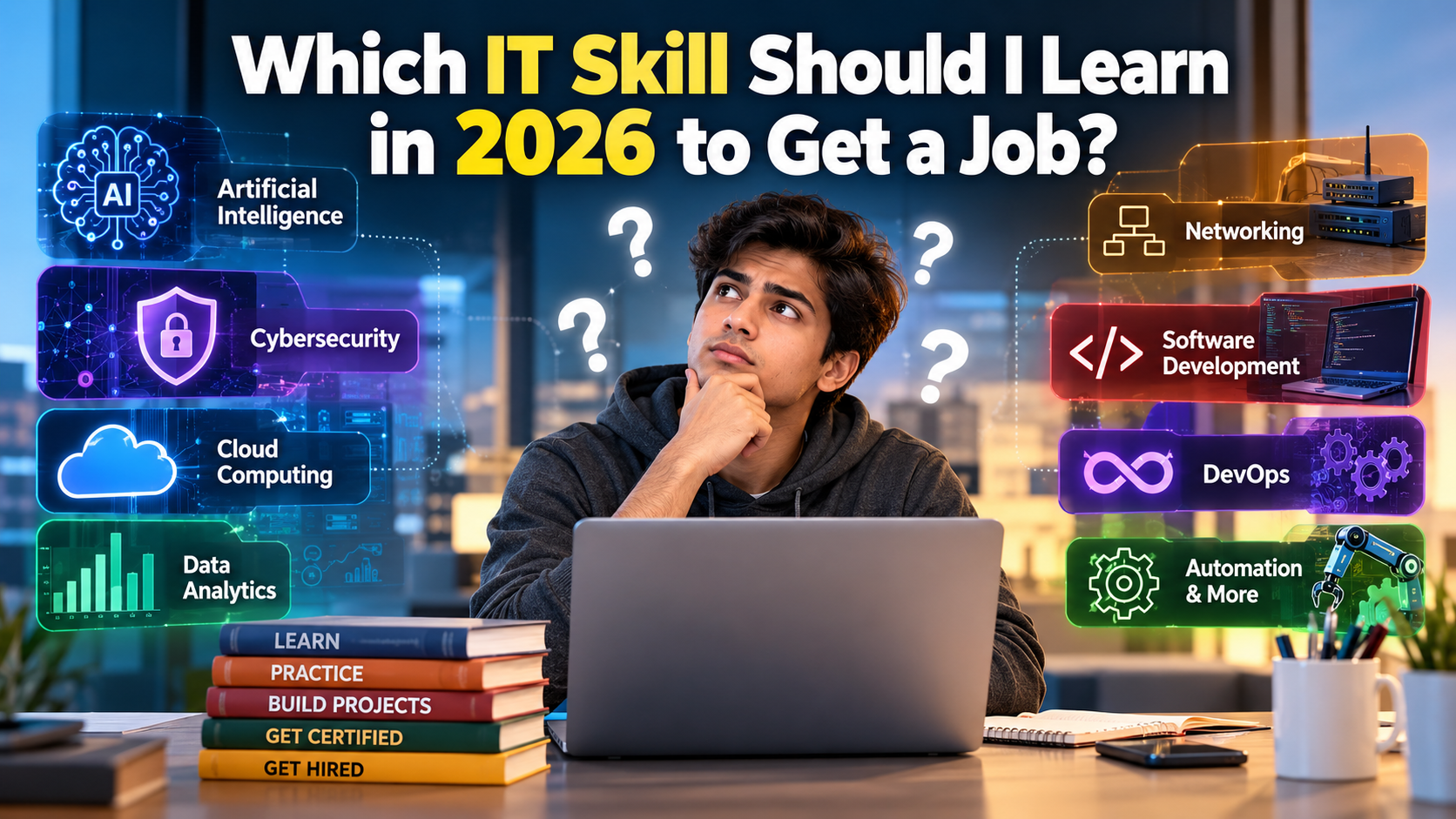
The IT industry is changing fast. Here’s how students, graduates and beginners can choose the right technology skill and build a job-ready career.
Every year, thousands of students search for the same answer:
“Which IT skill should I learn to get a job?”
In 2026, the question has become even more important.
Artificial Intelligence is changing the way people work. Cloud platforms are becoming a core part of IT infrastructure. Cybersecurity threats continue to evolve. Businesses are becoming increasingly dependent on data.
With so many technologies available, beginners often make the same mistake:
They try to learn everything.
AI.
Cloud.
Cybersecurity.
Programming.
Networking.
Data Analytics.
DevOps.
After a few months, they know a little about everything but aren't job-ready in any one area.
The better approach is simple:
Choose one career path. Build strong fundamentals. Practise. Build projects. Then expand your skills.
Here are some IT skills worth considering in 2026.
1. Artificial Intelligence and Generative AI
AI has moved from being a specialized technology to becoming a tool used across many industries.
Developers use AI to write and review code. Analysts use it to work with data. Businesses use it for automation and customer support.
If you're starting your AI journey, you can begin with:
-
Generative AI
-
Prompt Engineering
-
AI tools
-
Python
-
APIs
-
Large Language Models
-
AI automation
-
AI agents
But don't make the mistake of thinking that simply knowing how to use ChatGPT makes you an AI professional.
The real value comes from knowing how to apply AI to solve problems.
Build something.
Create an AI chatbot.
Automate a repetitive task.
Build a document summarization system.
Create an AI-powered application.
That's where learning starts becoming practical.
2. Cybersecurity
Every organization connected to the internet faces cybersecurity challenges.
That makes cybersecurity an important area for people interested in technology, networking and problem-solving.
But cybersecurity isn't just about learning hacking tools.
A strong cybersecurity foundation starts with:
Networking → Linux → Windows → Security Fundamentals → Security Tools → SOC → Incident Response
You can then specialize in areas such as:
-
SOC Operations
-
Threat Hunting
-
Penetration Testing
-
Digital Forensics
-
Cloud Security
-
Security Engineering
If you enjoy understanding how systems work and finding ways to protect them, cybersecurity may be worth exploring.
3. Cloud Computing
Walk into almost any modern IT environment and you'll find cloud technologies somewhere in the infrastructure.
AWS, Microsoft Azure and Google Cloud are major cloud platforms used by organizations around the world.
For beginners, start with the basics:
-
Virtual Machines
-
Storage
-
Networking
-
Identity and Access Management
-
Databases
-
Monitoring
-
Cloud Security
Don't try to learn every cloud platform at once.
Pick one.
Learn it properly.
Build a project.
Then move forward.
A simple roadmap can be:
Cloud Fundamentals → AWS/Azure → Projects → Certification → Job Applications
4. Data Analytics
Businesses don't just need data.
They need people who can understand it.
That's where data analytics comes in.
A beginner can start with:
Excel → SQL → Power BI → Python
You can learn:
-
Advanced Excel
-
SQL
-
Data Cleaning
-
Power BI
-
Data Visualization
-
Statistics
-
Python
But remember:
Data analytics isn't about making beautiful dashboards alone.
It's about answering business questions.
Why did sales fall?
Which product is performing best?
Which customers generate the most revenue?
What trend should the management team know about?
That's the real value of analytics.
5. Networking
Sometimes the most exciting technologies aren't the most fundamental ones.
Networking is a good example.
Cloud computing depends on networking.
Cybersecurity depends heavily on networking.
IT infrastructure depends on networking.
And users still need reliable networks every day.
Start with:
-
TCP/IP
-
OSI Model
-
IP Addressing
-
Subnetting
-
Switching
-
Routing
-
VLANs
-
DHCP
-
DNS
-
Network Security
Once your fundamentals are strong, you can move toward CCNA-level knowledge.
Networking can also become the foundation for a career in cybersecurity, cloud or infrastructure.
6. Full-Stack Development
If you enjoy building things with code, software development remains another path to explore.
A possible roadmap is:
HTML → CSS → JavaScript → React → Node.js → Database → APIs → Cloud
But don't spend six months only watching tutorials.
Build something.
Build a website.
Build a student management system.
Build a job portal.
Build an e-commerce application.
Build an AI-powered application.
Your project tells a potential employer something that a list of completed tutorials cannot:
“I can actually build things.”
7. DevOps and Automation
Modern companies want to develop, test and deploy software efficiently.
That's where DevOps and automation become important.
You can start with:
-
Linux
-
Git
-
GitHub
-
Docker
-
CI/CD
-
Cloud
-
Kubernetes
-
Infrastructure as Code
-
Monitoring
If you enjoy infrastructure, automation and cloud technologies, DevOps can be an interesting career direction.
A useful combination is:
Linux + Cloud + DevOps + Automation
What If You Don't Have an Engineering Degree?
This is one of the most common questions beginners ask.
The answer is that IT has many different roles, and educational requirements vary by employer and position.
Some roles may specifically require a particular degree.
Others may place greater emphasis on relevant skills, certifications, projects and experience.
So instead of asking:
“Do I have the right degree?”
Ask:
“What skills does the job I want require?”
Then build those skills.
Don't Collect Certificates. Build Skills.
A common career mistake is collecting certificates without developing practical knowledge.
You can have five certificates and still struggle to explain how a technology works.
A better formula is:
Learn → Practise → Build → Certify → Apply
Learn the concept.
Practise it.
Build something with it.
Get certified if the certification adds value.
Then apply your knowledge.
Your Projects Are Your Proof
Imagine two candidates applying for an entry-level cybersecurity role.
Candidate A says:
“I completed a cybersecurity course.”
Candidate B says:
“I built a security lab, analysed network traffic, investigated logs and documented security findings.”
The second candidate has something concrete to discuss.
That's why projects matter.
Your portfolio doesn't need to be complicated.
It needs to demonstrate what you can actually do.
Don't Forget Communication Skills
Technical skills are important.
But IT professionals don't work alone.
You may need to explain a technical problem to a customer.
You may need to write an email to your manager.
You may need to document an incident.
You may need to explain your project during an interview.
So while learning technology, also improve:
-
Communication
-
Problem-solving
-
Documentation
-
Presentation
-
Teamwork
-
Professional writing
Technical knowledge gets you into the conversation.
Your ability to communicate helps you contribute effectively.
So, Which IT Skill Should You Learn in 2026?
There isn't one correct answer.
If you enjoy:
Computers and troubleshooting
→ IT Support
Networking
→ Networking / CCNA
Security
→ Cybersecurity
Infrastructure
→ Cloud Computing
Numbers and business
→ Data Analytics
Programming
→ Software Development
Automation
→ DevOps
Artificial Intelligence
→ AI / Generative AI
And you don't have to stop there.
Once you become comfortable in one area, combine it with another.
Cybersecurity + Networking
Cloud + Cybersecurity
Python + AI
Data Analytics + AI
Cloud + DevOps
These combinations can help you build a broader professional skill set.
The Most Important Skill in 2026
Here's something that often gets forgotten.
Technology will continue to change.
The tool you're learning today may be replaced by another tomorrow.
That's why one of the most valuable career skills is:
The ability to keep learning.
Don't build your entire career around one software tool.
Build strong fundamentals.
Understand concepts.
Practise regularly.
Build projects.
Stay curious.
Keep learning.
Final Thoughts
You don't need to learn every technology in the IT industry.
You need to find one direction that fits you.
Then go deep.
Learn the fundamentals.
Practise.
Build projects.
Improve your communication.
Create a professional portfolio.
Start applying.
And continue learning even after you get your first job.
Because an IT career isn't built by learning one technology.
It's built by continuously developing your ability to solve problems with technology.
Choose your path. Learn the right skills. Build something real. Start your IT career in 2026.
About Global SkillTech
Global SkillTech provides career-focused training in areas including Cybersecurity, Networking, Cloud Computing, IT Infrastructure, AI and Data Analytics, with an emphasis on practical, hands-on learning.