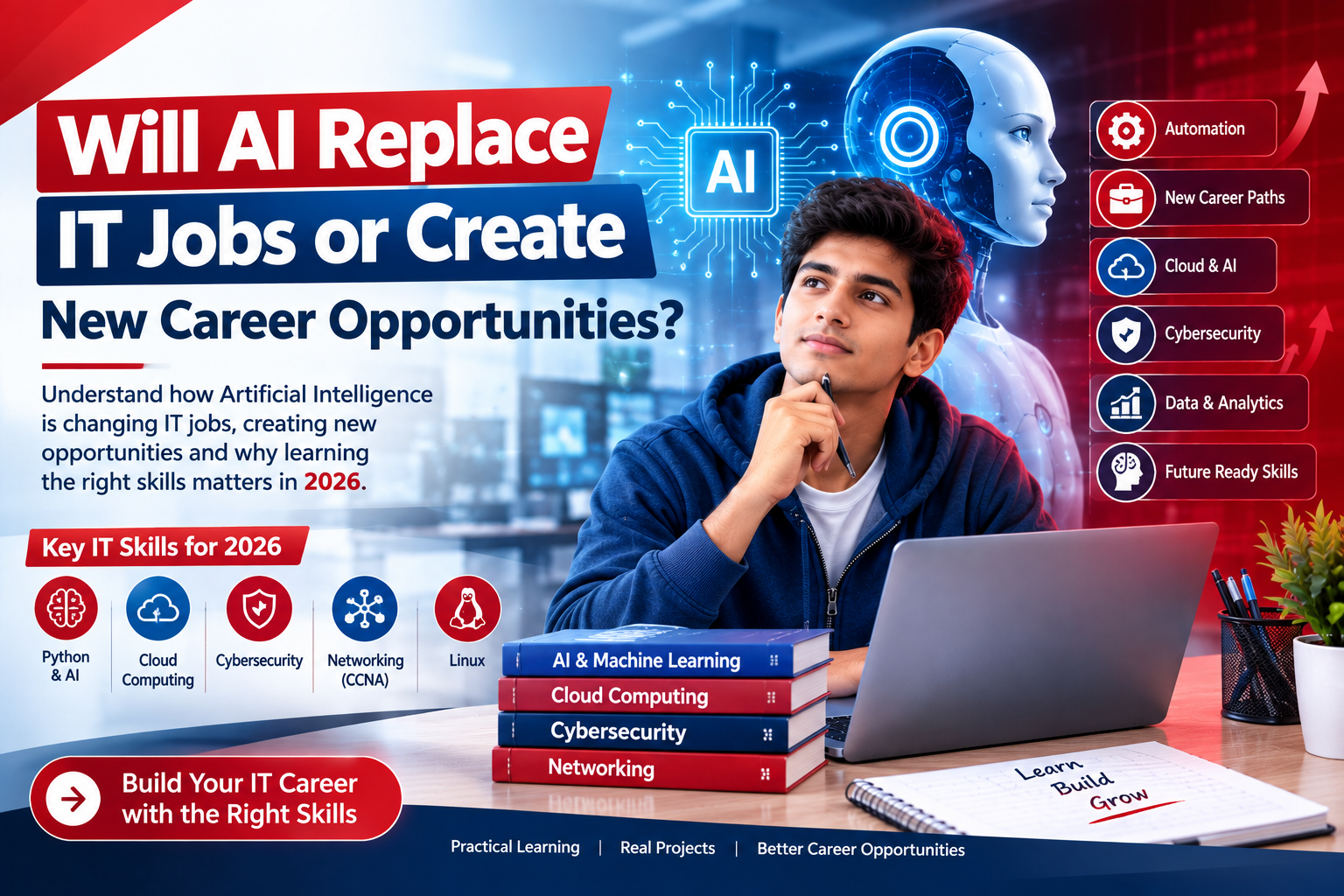
Will AI Replace IT Jobs or Create New Career Opportunities?
Subtitle: Understanding how Artificial Intelligence is changing IT jobs, creating new career opportunities, and why learning the right technical skills matters in 2026.
Artificial Intelligence (AI) is changing the IT industry faster than ever. From automated customer support to AI-powered cybersecurity tools, businesses are using AI to improve productivity, automate repetitive tasks, and make better decisions.
This has created an important question for students, freshers, and IT professionals:
Will AI replace IT jobs, or will AI create new career opportunities?
The answer is more nuanced than simply saying “AI will replace jobs.” AI is changing how IT professionals work, while also increasing demand for people who understand AI, cloud computing, cybersecurity, data, networking, and automation.
How AI Is Changing IT Jobs
AI can automate many repetitive and predictable tasks. For example, AI tools can help with:
-
Basic technical support
-
Code generation
-
Data analysis
-
Documentation
-
Network monitoring
-
Security monitoring
-
Testing and troubleshooting
-
Customer service
-
Report generation
However, IT jobs often require more than completing repetitive tasks. Professionals also need to understand business requirements, troubleshoot complex problems, communicate with teams, make decisions, and manage technology environments.
This means the role of an IT professional may change rather than simply disappear.
AI Is Creating New IT Career Opportunities
As companies adopt AI, new technical requirements are emerging.
Some growing areas include:
1. AI and Machine Learning
AI and machine learning require professionals who can work with programming, data, models, and AI systems.
Beginners can start with Python, SQL, basic statistics, and AI fundamentals before moving into advanced AI projects.
2. AI Automation
Businesses are increasingly interested in automating repetitive workflows.
IT professionals who understand Python, scripting, APIs, automation tools, and AI platforms can work on automating business and technical processes.
3. AI-Powered Cybersecurity
Cybersecurity is also being influenced by AI.
Security teams can use AI to help identify unusual activity, analyze large amounts of security data, and support threat detection.
This makes the combination of networking + Linux + cybersecurity + AI increasingly useful for IT learners.
4. Cloud and AI Infrastructure
AI applications require computing infrastructure, storage, networking, and cloud platforms.
This creates opportunities for professionals who understand cloud computing, Linux, networking, virtualization, and AI infrastructure.
5. Data Analytics
AI depends heavily on data.
Learning SQL, Python, Excel, data analytics, and visualization can provide a foundation for working with data-driven technologies.
Will AI Replace IT Support Jobs?
AI can automate some basic IT support activities, such as answering common questions, creating documentation, or assisting with simple troubleshooting.
But IT support professionals still deal with hardware, operating systems, networks, users, security, configurations, and problems that may require human investigation.
For this reason, IT support professionals can benefit from learning additional skills such as:
-
Networking
-
Linux
-
Windows Server
-
Cybersecurity
-
Cloud computing
-
PowerShell
-
Python automation
-
AI tools
The future IT support professional may use AI as a productivity tool rather than compete with it directly.
Why Networking and Linux Still Matter
AI does not work in isolation.
Modern AI applications depend on computers, servers, networks, operating systems, databases, and cloud infrastructure.
That is why foundational IT skills remain important.
For beginners, networking and Linux can provide a strong foundation for later learning cloud computing, cybersecurity, DevOps, and AI infrastructure.
What Skills Should You Learn in 2026?
There is no single IT skill that guarantees a job. Your choice should depend on your background, interests, and the type of role you want to target.
Some useful combinations include:
For AI:
Python + SQL + Statistics + AI fundamentals
For Cybersecurity:
Networking + Linux + Security fundamentals + Cybersecurity tools
For Cloud:
Linux + Networking + Cloud platform + Automation
For IT Support:
Computer Hardware + Windows + Networking + Linux + Troubleshooting
For Data Analytics:
Excel + SQL + Python + Data Visualization
The important point is to avoid collecting many courses without developing practical ability.
Skills + Projects Matter
Learning a technology is only the first step.
You should also build projects that demonstrate what you can actually do.
For example:
-
Build a Python automation project
-
Create a SQL database project
-
Configure a networking lab
-
Create a Linux server environment
-
Build a cloud deployment project
-
Create a cybersecurity lab
-
Develop an AI-based mini project
Projects can help you demonstrate your technical knowledge during interviews.
AI Is Becoming an Important IT Skill
Recent industry research referenced in the GlobalSkillTech IT-skills guide reports increasing employer interest in AI-related hiring and strong demand for AI, data analytics, cloud computing, cybersecurity, and related technical skills. The guide also recommends building foundational skills such as Python and SQL before progressing into AI projects.
The same research notes that employers increasingly value demonstrable skills, projects, and certifications alongside traditional educational qualifications.
The Future: Humans + AI
Instead of thinking only about “AI vs humans,” it may be more useful to think about “humans using AI.”
An IT professional who knows how to use AI tools effectively can potentially complete certain tasks faster while spending more time on troubleshooting, planning, problem-solving, security, and business requirements.
The most valuable approach for beginners is therefore to build strong IT fundamentals and then add AI skills.
A Simple Learning Roadmap
If you are starting from zero, you can follow this path:
Step 1: Learn computer fundamentals
↓
Step 2: Learn networking and operating systems
↓
Step 3: Learn Python and SQL
↓
Step 4: Choose a specialization
↓
Step 5: Add AI and automation skills
↓
Step 6: Build practical projects
↓
Step 7: Create your resume and portfolio
↓
Step 8: Prepare for interviews and apply for relevant jobs
For beginners, the research guide suggests that foundational skills such as SQL, Python, Linux, and networking can provide a base for later specializations including AI, cloud, cybersecurity, and data careers.
Conclusion
So, will AI replace IT jobs?
AI will certainly automate some tasks and change the way many IT professionals work. At the same time, AI adoption is creating demand for new skills involving AI, automation, data, cloud infrastructure, cybersecurity, and technology management.
The key is to keep learning.
Instead of trying to compete with AI on repetitive tasks, IT professionals can learn how to use AI, manage AI-enabled systems, secure technology environments, automate workflows, and solve complex technical problems.
For students and freshers, the best starting point is to build strong fundamentals and then gradually add AI-related skills.
AI may change the IT job market, but learning how to work with AI can create new opportunities for people who continuously develop their technical skills.
Learn More
If you are looking to develop practical skills in Networking, CCNA, Cloud Computing, Cybersecurity, Linux, IT Support, and AI, explore the programs available at Global SkillTech.
Website: https://globalskilltech.in/